HISTORY REPEATS ITSELF AGAIN

one of my art history books found at a sale that I’ve been reading through. It will join the others to go to Half Price books later.

People often buy books like this for the coffee table and don’t bother to read them unless they’re taking a class and it’s a textbook. It doesn’t read like a text book but has some interesting text that applies to the world societies we live in today, and I don’t mean just about art. One interesting item I found happened in the Early Chou Dynasty, c. 1100 b.c.-256 b.c. During the warring states period of 403-221.

“The rich began to gather huge landholdings, forcing the poor to become landless tenants. As warfare among the states increased, taxes rose to unbearable heights of 50% or more; many tenant farmers owing more than they could produce escaped to join indigent, non-productive, and disruptive elements. (p. 42).

Homeless camps can be seen not only in America, other countries around the world too are suffering this growing crisis.

There is a long list of blames for the reason these encampments are seen in basically every city. It began with the opioid crisis and bad tenants, soft government and the tanking values of commercial properties sending investors into the residential markets. With the growing number of short term rentals catering to tourism and nomad workers, such as those who can work from home or anywhere, has contributed tremendously to this crisis. As I travel around my own metro area and witness the growing suburban landscape stretching out beyond the farthest suburbs, Urban Sprawl. I notice the mega apartment buildings, townhome communities and new neighborhoods of single family homes all have one thing in common for these new home owners, Home Owner Associations, (HOA’s)

All HOA’s charges each family a monthly fee on top of their mortgage payments. This fee can be low or high and is often increased over time. Most people are convinced these HOA’s are in place to protect the homeowner’s home values and keep the neighborhood nice, but they’re really dictating conformity and ousting diversity and individualism. I lived in a coop and we too had rules to prevent problems, the rules were simple and made sense. Though we were all renters at the time we tenants were allowed to plant gardens front and back, allow our visitors to park in front on the street or in our driveway or a designated spot in a lot, and we were allowed to paint our property in colors of our own choosing, etc. HOA’s dictate everything you do and I find them extremely intrusive. HOA’s usually have a management company of sorts handling the money collected and leaving homeowners with next to nothing in return. In a coop, there too was a management company, but members also managed the properties and there was a process for complaints when another member broke the rules and disturbed other people. Everyone had a right to see the books, what is in the bank and what the money was spent on. We got whatever we were paying for. No one is allowed to impose on another neighbor their own “standards”, such as is a common thing in HOA’s. However too many people believe that the coop concept is communist!

A homeowners coop could easily offer affordable homeownership and eliminate the management company and all other middlemen. Coop members manage the properties themselves through various committees. They could eliminate the HOA fees but ask homeowners to pitch in or volunteer in the upkeep of common property, maybe require a small fee to keep in trust for expenses of common areas. Form workshops that offer classes on “do it yourself” home maintenance and more. Create community gardens that grow produce and anything else to benefit members. The ideas are endless.

What I see in HOA’s is a gimmick to keep home owners paying something to the landowners or developers for many years beyond their mortgages. Who actually owns these management companies, probably not the small business guy. Not all people are dissatisfied with their HOA, but the trend these days is moving toward normalizing these fees into our daily lives and as in nearly everything that starts out small and friendly, grows into a very large and dissatisfying beast. I can testify to that personally with all the small start up companies I have worked for in the past, as they grew and took on more people, they began chipping away at all the perks and benefits I had earned. They don’t appreciate you and all the work you’ve done and are still doing to contribute for their success. Remember, it’s Their success, not yours!

People say to vote for change, but we need to do more than vote. We can vote for anybody and nothing changes, but if we take to the streets that drives our messages into the skulls of the powers that be. They need us, we don’t need them! Maya Angelo said in her book, “The Heart of a Woman” a piece of advice her African husband told her before she set out to enter a building where there was a protest going on. He told her if things got scary not to trust the assistance of somebody of the middle class because they are scared of losing whatever they have, but to trust the somebody who looks like they don’t have anything to lose and color means nothing in these situations. She took his advice and was successful in entering that building unmolested.

Boycotting capitalism itself is a start as this system has grown into the disparity we are all becoming more familiar with today. Nothing is going to change unless everybody stops spending their money on new stuff. Unfortunately, we know that’s not going to happen.
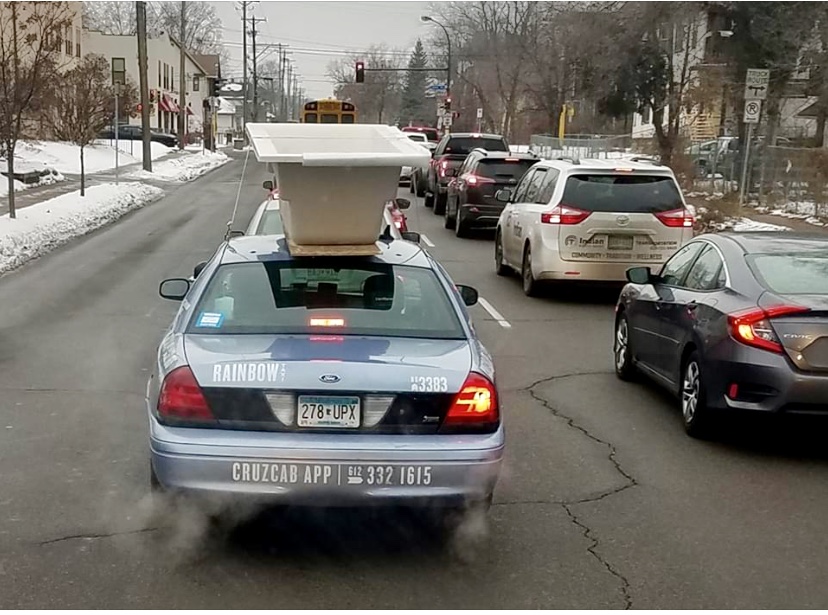
MOVING TIME IN MINNEAPOLIS?

As the people around the city and even surrounding areas are concerned about the threat of Uber/Lyft leaving Minneapolis over the controversy of the city council’s belief in “minimum wage” and ability to over ride vetos from the mayor and the governor, I would like to help by enlightening people to one of the elements that brought this to the point of where it is now. Cheap!

With the media coverage about anti-tipping the public in general turned against tipping. This trend seemed to have started with the early days of Uber who claimed that a 20% gratuity would be added to the fares charged customers and then that’s all they would take of the fare from the drivers. Well, that’s not true anymore. Since then customers can scroll down and choose a tip in the app, but cash is still King. However, customers are not tipping and helping to make up the incomes of drivers, nor other servers for that matter. In order to keep prices low, tipping is a necessity. Restaurant servers have told me that if tips were eliminated and they were only paid the minimum wage to do their job, they’d quit. I used to waitress and the wages for wait staff was well below minimum wage, but I came home with a lot more money in my pockets than any minimum wage would’ve paid me. The kitchen staff often envied this because they only were making a wage but somehow there was a law or ordinance passed that prevented restaurants from demanding a small percentage of tips to contribute to the staff in the kitchens. Waitresses are often young and pretty and age out of the occupation or move on to other venues such as diners and truck stops that don’t pay in tips as well. It’s not considered a profession.

Remember the days starting in the early 1980’s (if you were around then) when companies first began moving out of the country and made the claim that the U.S. economy was going to be a service economy?

I remember that well. I also remember the beginnings of the “gig” economy that was back then called “independent contractors” and many companies jumped on that bandwagon in the early 1980’s too. This “Gig” economy is growing as more workers are jumping on the bandwagon. What are the advantages? The freedom to work whenever you want or need to, be your own boss, own your own business! However we’re still dependent on a main source or company for our business. We’re not entrepreneurs creating anything new, even the independent car services, calling themselves limos most often began working for another company, usually a taxi company, and poaching business from there before striking out on their own.

The original manuscript for this book is unknown, but was first published in China in 1937. The translation edition here dates to 1945.

This story describes the life of the equivalent of today’s taxi and Uber/Lyft drivers and to also include the lives of all gig workers to come. When people like what they’re doing, they tend to keep doing it even though it may not be any good for them in the long run, however, they’re still working and eking out a living. Drug addicts do this that’s why they go on to becoming addicts in the first place, autistic adults are only now becoming apparent and autism has a wide spectrum so most people who are autistic don’t know they are and neither do people in general outside the mental health community. Drivers aren’t just stupid, they’re stuck in the rut for a reason. The future they don’t see is very bleak. At the same time companies have this upper hand and though employers have responsibility to their employees, something our past generations have fought very hard to make into law, such as minimum wages, anti-child labor laws, workers compensation, unemployment insurance and pensions. All of which companies avoid by making their employees “independent contractors” and boosting the egos of these employees with words like, “be your own boss”, etc. It’s time for all gig workers to rise up and figure out what is going to work to protect all of our futures.

Gig workers do not have wages, we are not paid by the hour, we do not have benefits that every other worker has. We have to make our own through savings and IRAs. We pay for our own expenses. There is no responsibility of any company to protect us by law. The city of Minneapolis is not going to change this by demanding Uber/Lyft to pay a minimum wage. In fact it was the city council that ousted the owners of Yellow taxi from the city in 1982 by not working something out when Yellow lobbied for leasing rather than the commission they were then paying drivers, which was generally a 60/40 split with Yellow taking the 60% of the fares and paying all expenses including employee coverage of all responsibilities of employers. Drivers made a middle class income, were able to buy their own homes, support their families, and even save for a pension through an employer’s plan. The city council took that away from taxi drivers in 1982. So what are they going to do now, re-invent the wheel? Bring back the taxis? I have another whole blog about the taxi companies and their operations and political entrenchments. Uber/Lyft actually made things better for all drivers.

On one hand, I don’t blame the drivers who lobbied their complaint that Uber/Lyft aren’t paying enough. Over time, like everybody else, taxi companies included, have pecked away at the earnings of the people who do the work for them. They only offer an endless string of excuses to disguise their greed. Once they build up what they strived for, which is an over abundance of workers, then they began their pecking away at the earnings. It’s nothing new and we’ve all experience it in some form. What at first was overtime and the tantalizing offers of overtime pay, is now taken for granted as workers find themselves working overtime every week just to make expenses. They also continue to raise the age of retirements claiming the people are living longer. Who’s living longer, the privileged? Not the average worker who’s become tired and worn out, maybe a few survive to old age.

Remember when most recently after the Covid 19 pandemic, workers began demanding more wages, what did a lot of companies, big and small, say? If they had to pay more in wages then they’re going to raise prices. And they did just that with the excuses of “chain supply problems” etc. Now they’re squawking about shipping problems by sea. All of which could have been avoided in the first place if they hadn’t slung their manufacturing hooks out of the country and just kept wages up with inflation. Consumer too contribute to this with all the frivolous shopping and demand. People in general are cheap and they want to stay cheap without feeling that they are cheap, so all this anti tipping hype and even blurbs about the history of tipping originating from slavery, only gives cheap people an “opinion” making them feel that they’re contributing to an age old custom of oppression. The reality is, the service industry does depend on tips to keep prices low so generally anybody can afford the service because tips supplement the incomes of servers in order to keep restaurants, taxi’s, Uber/Lyft viable to the consumer to enjoy the luxury.

As I write this there is a fresh beef going on with China possibly overproducing and fear of undermining the cost of goods exported from China to consumers. Actually the companies themselves are in fear of the competition. They’re losing the upper hand they had when they first began exploiting the cheap labor in China, now they’re complaining?

Fear is still the driving factors in all this hype over China spying on us so we have to do away with TikTok. It’ll be Chinese business next, like Temu, etc. Just watch!

VIRTUAL REALITY LIFE vs. ACTUAL REAL LIFE

Stolen Vehicles on the rise, though the bus in this photo wasn’t’ stolen.

I. had a customer enlighten me to something I never thought about, he said “kids these days aren’t watching television, they’re playing games on their computers and phones”. 

Virtual Reality has been here for a number of years now but though the market for goggles seems to be falling, and AI is now all the rave, what are online games doing? They’re virtually taking kids off the couch and making them participants on the screen. They create their own fantasy selves with Avatars and compete with their online peers. Many of these games cost money and more and more people are either unable to afford to pay for those games, or kids are just taking their virtual selves off the screen and into real life. Stolen vehicles have been reportedly on the rise since the pandemic and the blame is going on the pandemic as these kids were taken out of school and allowed to run wild in the streets. I have to wonder about that, like many Americans these days, there are many doubts to think about when we hear something on the news. We can blame irresponsible parents for allowing their children to run wild in the streets, or the lack of learning aids to poorer families who relied on public computers. However, many people also stepped up to donate tablets and laptops and refurbished used gear to these under privileged kids, there was still something lacking. Kids these days have more tools and resources than I could ever have even imagined when I was a kid myself. We had nothing but each other to rely on. We had bikes to ride but we never got new, always used and we learned how to fix them and take care of them. Our parents had the time to teach us crafts, like sewing or woodworking, things that encouraged our creativity. There was participation in Scouts, something that is still around today.  Our games were with other kids in the neighborhood, like “kick the can” etc. Or explored our environments. Learning to fix things was also a skill we learned from a parent or someone else in the neighborhood. Hobbies, most of us had hobbies, and kits also aided in kids learning to build things, like models, etc. My brothers went from learning to fix bikes to fixing cars and are now all successful mechanics with good jobs and self-employment.  Not all these juvenile games and activities outdated today, but we don’t hear much about them anymore and parents either lack skills themselves or just don’t have time because they’re working all hours to pay for the new, throw away society we’ve become. As juveniles, we were outdoors and running wild in the streets ourselves, except if we, say broke someones window whether deliberately or accidentally, our parents were often held responsible to replace it and in turn we would have to earn the money somehow to pay them back. We learned how to get and do jobs. We knocked on doors and offered to shovel sidewalks, pull weeds, mow lawns, run errands like go to the store. It didn’t take long before our parents were satisfied with what we made the effort to go out and do to take responsibility for our own actions. Not only did we have to pay for our damages at the time, we also got our butts whooped and grounded for a period of time while doing chores around the house. These days all that stuff is being called “child abuse”. That would’ve been laughed at back in my juvenile days, but today children can actually sue their parents. After driving a school bus for awhile I had also learned that when a bus driver is accused of something done to a child, the district is open to a lawsuit by the parents. Fair enough if something heinous really did occur, but instead of the district fighting the lawsuit it’s just cheaper to pay off the family. So where does this lead to? What’s sad about this is it nearly encourages false accusations for personal gain at the expense of everyone else while real abuse does go on somewhere else. If there is a way to abuse a system, you can bet there are people out there to find it and do it. Now kids shooting up a school is becoming a norm. 

So, finding a virtual way to participate maybe an influencer to find a real way to participate, or like AI, aid in generating ideas. An age old Celtic method of dealing with restless youth was for the older members of the group to take them out into nature and rough it. Kids learned skills while burning off that energy. They learned to be self sufficient, cooperate with each other, and mindful of others. They also learned to know more about themselves. A friend of mine used to work at a youth camp that did just that. It was designed for troublesome kids and has probably saved many of these same youths from a lifetime of criminality. However, these programs were cut from the government budget. A sad case of where are we going today toward a better future? 

The Buzz Du Jour: OWN NOTHING?

What is happening to home ownership!

Luckily I bought my house 20 years ago before prices doubled to what they are now. It’s a duplex that was once owned by a neighborhood wide coop. I bought as a partner with the other tenant downstairs. As partners we’ve had our ups and downs, but we’re still partners and get along well enough. We’re both older, her now elderly and me not far behind, and neither one of us will probably not live long enough to pay off the mortgage. Oh well, can’t take it with you, eh! When I was young, all I heard about home ownership were the pitfalls, ”What if the furnace goes out! What if the roof needs to be replaced!” All discouraging words. I never made much money driving taxi but I’ve had both the boiler, not furnace which is much cheaper than a boiler, and the roof replaced and I’m still better off than renting. We had to refinance the house to do the roof because it’s a common expense, we each have our own separate heat source, but that was only because my partner doesn’t save her money so when something has to be done, she has no money to deal with it, however, she does have borrowing savvy. Interest rates fell very low at the time and we got more of a rebate than a loan. My share of that rebate went straight into savings! I call it my house fund, or rainy day fund.

Anyway, back in my parents time, a typical mortgage was about 10 years and most people would pay their house off before that 10 years was up because they could. What is that 10 years now? 30, 40, going on 50?  I would still encourage home ownership because wherever you live your are still going to have to pay for the shelter over your head. Even if you have to have a partner on a house, it is so much better than renting. The coop never prevented tenants from painting their walls other colors besides the standard “renter’s white walls” or doing work on the house they wanted to make themselves more comfortable and happy. There were some people who criticized the coop as communism. Silly labels people make up when they don’t really understand something. If we could only just take what is good from any system of government and utilize it for our own good then I don’t find anything wrong with it, so label it as you like, communism, socialism, whatever. Ask yourself this where is capitalism taking us not so privileged commoners? Somehow this feels like we’re going back in time. I’m not anti capitalistic, but we’ve been so dumbed down over the generations, like frogs in the boiling water. Also back in my parents time, credit cards were not common as they are today. You had to be rich to have a credit card, but people were able to put the desired item on lay away. They didn’t get it until they paid for it in full, they also didn’t pay interest. Now even a used car is going out of reach. I drive Uber and Lyft these days and I hear a lot of my riders complain about not being able to find a used car or able to afford one. Back in my parents time, people didn’t take out loans to buy a used car. 

Awhile ago, I had two riders in my car, a father and his son. Obviously they owned their own business. The father was advising his son on hiring employees. He told him this: “Brains are easy to come by, you want to hire the guy who is married, has a family to support, a mortgage and a car payment”. Upon hearing that, “Trap! Trap! Trap!” is what jumped into my mind. Owning Nothing is also a trap. That might be good for people who are in a position not to care, either the young who are always on the go, or the older ones who have the money to live on cruise ships or in assisted living homes. While people criticized me for being sucked into the coop and accused me of communism, they live in homes that are not their own though they are paying a mortgage, such as town home communities that won’t allow them to paint their home whatever color they like or even put an antennae on their roof and Home Owners Association fee on top of their mortgage! I recently heard reported that one HOA wouldn’t allow a homeowner to install solar panels on their roof! Members vote on what you can and can’t do and you can count on the fact that there will always be one to throw the monkey wrench into your plans. Maybe they don’t care or maybe they just refuse to believe they’re not really happy. I wouldn’t be. The coop also allowed tenants to have pets and didn’t charge more for rent though did ask a little bit for a damage deposit. Since the commercial real estate has tanked due to online shopping and now investors have moved into residential real estate, rents have more than doubled in a very short time. Unfortunately, private landlords also take advantage of this new bonanza of charging more rent for their properties, so every renter now suffers.  Management companies manage the properties and care nothing for the tenants just as the investors care nothing about them, just do your job and pay your bills! Working long hours and the chipping away of benefits are another thing. We’ve been sucked into that too starting with good overtime pay so that we can afford to buy the latest fashion and trinket that comes across out television screens, or to pay towards a loan or credit card. As these landlords have shown us, we’re all greedy to a degree, some more than others but we’re still greedy. If we can get more, of course we go for it, it would be stupid not to, right? 

This is now a bad time to purchase a home, high interest rates and we might be in for a long wait before the price of housing comes back to affordability, but I would still encourage anyone to take advantage of any opportunity to own your own! That rubbish about own nothing is just that, you’ll only be under the thumb and vulnerable to poverty and “wage slavery” all the more. I see huge apartments and town home complexes going up far into the country incorporating farm land into suburbs.  The town homes all look pretty much alike, a sterilized standard as to what you plant in the front yard, (no vegetable gardens) etc. they all comply. The apartment complexes are humongous, well over a hundred apartments in one building! Tiny apartments that cost more than a mortgage payment and the renter walks away with nothing at the end. When you own a house, you walk away with generally more than what you paid for it, you’re not leaving with empty pockets unless you just give up and quit or let the bank foreclose on you. You screw up your credibility when you do that. You’re not just dumping it on bank or somebody who you think is rich, what do they care, they just sell it to the next guy and keep all your equity, they’re making money while at the same time you’ve betrayed a trust. What say you borrow as little as $5.00 from a billionaire and don’t bother to pay it back, why would that same billionaire trust you to borrow more? It’s not about the money, it’s about trust. That billionaire could care less about the $5.00, no dent in that wallet, but it’s going to affect you a whole lot more. 

Capitalism for Everyone

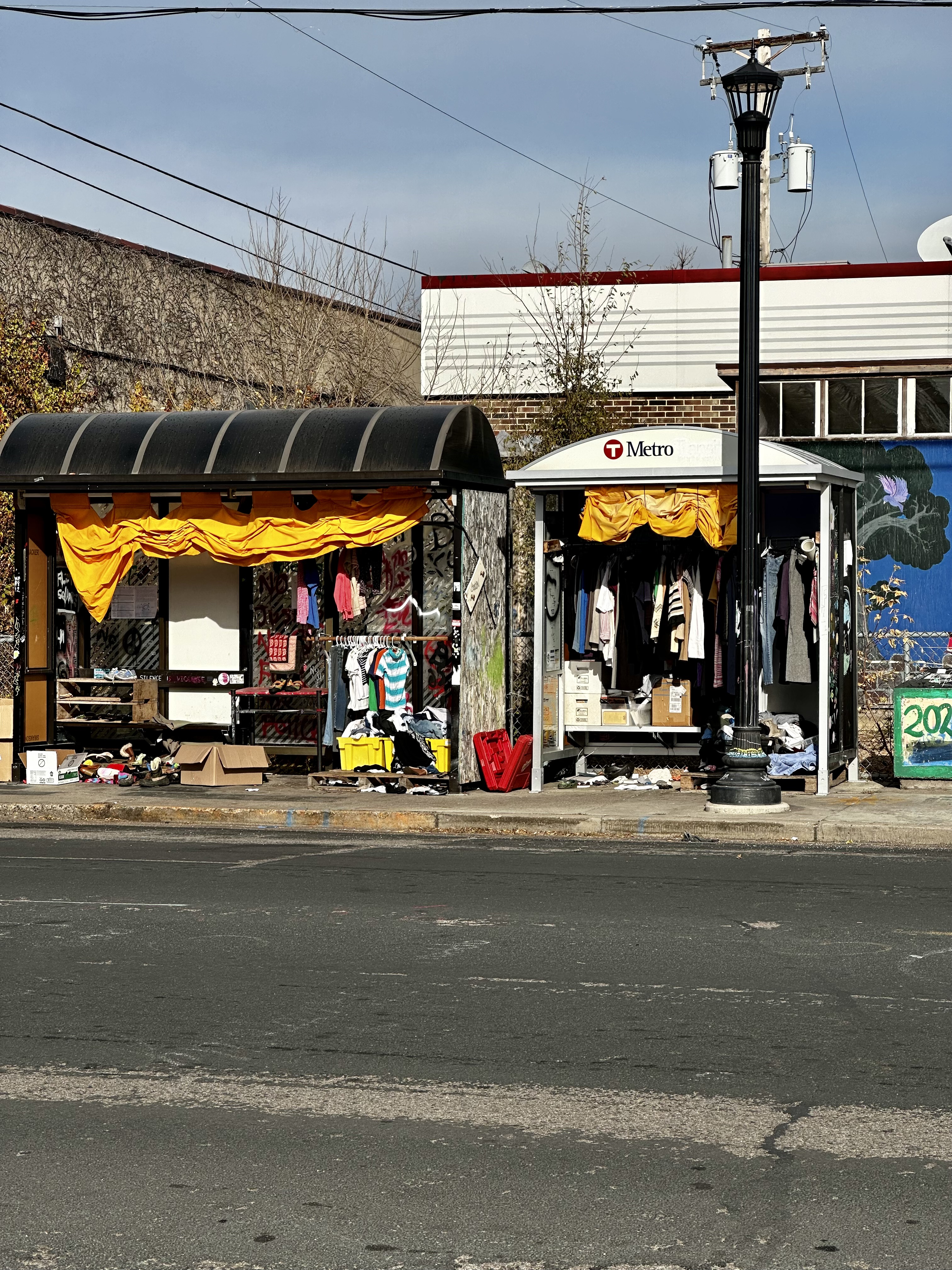
Open for business or is this a free store?

These bus shelters offer a rent free opportunity to anyone bold enough to set up a business. You can find this shop at what is now “George Floyd Square”, the intersection of 38th & Chicago in Minneapolis. I don’t think Metro Transit uses these particular shelters anymore because of the round-a-bout and blockades make getting a big vehicle too difficult to get through.

Since I’ve been working the weekends driving Uber and Lyft, I haven’t been around the estate sales much and only a few yard sales throughout the summer. People don’t have yard sales here during the winter. Driving a cab, or the equivalent of a cab, these days is very different from the old taxi days when I worked downtown and ordinances kept me from picking up outside the city limits and taxis from outside the city limits were prevented from picking up fares in the city. A lot of things are nice about this, venturing around the entire metro area and sometimes beyond for one. I get to see more and learn more about the place I live in. The Minneapolis city center is all but dead anyway because after the riots those downtown apartments began to empty out as the people who moved in from the outer regions decided to move back out. The pandemic work-from-home has emptied out some of the office buildings too and now the city is talking about converting those into “affordable” housing. The bottom has been falling out of commercial real estate ever since shopping online became popular, now some people only shop online and barely venture out to shop anymore. Investors had moved out of the commercial real estate and into the private housing market and companies like RealPage uses algorithms that management companies and landlords use to set the rents and those algorithms were set high all over the nation. But high rents aren’t the only reason we’re seeing an increasing amount of homelessness, that’s more of a drug problem, a very big drug problem and mental illness. Even the old hoboes that have been homeless most if not all their lives because of alcohol and drug abuse say that this next generation is very different from their days on the streets and in the rail yards. The old school hoboes kept their camps out of site and weren’t the nuisance these ones today are. The synthetic drug abuse is much different from the old organic drug abuse is one reason and there are a lot more people affected by it too.

I don’t work in the city much anymore as most business has shifted out to the suburbs and beyond. I don’t see homeless camps in the suburbs, I don’t see people on the corners and freeway ramps holding up signs begging, and the roads are a lot smoother too.

We’re in a new era and it almost makes me feel my age. That’s a realization that can be hard to come by sometimes. Time moves on and we hardly notice the change until we find ourselves on the outside of a new generation. Though much remains the same we are very different, the world has changed and moved out of our age. It’s a generation gap. We might think we’re keeping up with the times, but really we’re not. We think different, look different, wear different clothes and most of all our memories are different. We might like the same music and even agree on many things, but that difference is there, just like our own parent’s difference was there to us when we were young.

I don’t ever remember seeing a bus shelter being used as a shop when I was young, I didn’t see homeless camps, but I have seen hobo’s camps, growing up near railroad tracks and many empty lots full of weeds. I remember black and white television and the fuzzy static when television programs ended for the night. I remember going to concerts and thinking $25 was a lot to pay for a ticket when prices rose from $15. Positively Fourth Street record shop where I bought numerous LPs at $4.99 each. They also had cool stuff, head shop stuff. Dinky Town Crazy Daze when all the shops in Dinkytown pushed their sales out onto the sidewalks and it was a big event that excited everyone. Ralph & Jerry’s convenient store where they sold T-shirts that advertised the store and encouraged everyone to “Eat and Spend Money.” I gave mine to a friend I met in New Orleans who came from Australia. Many years later when the Mall of America was close to opening, my same friend who became a journalist was sent here to do a story and I took him to Ralph & Jerry’s just so he could replace that T-Shirt with another. He bought one of the last of its kind because Ralph & Jerry’s is now gone and new owners have taken over the space.

Dinkytown has changed too. I grew up with a girl whose father owned The House of Hansen in Dinkytown, a small grocery store. The old folks in Dinkytown tried to persuade her not to sell her store to the developers but she was smart enough to see that holding out wasn’t going to do her any good and change was going to come anyway. Now a it’s a big building. So is the old high school, a huge tall building with a few shops on the bottom floors and apartments above. I’ve been on the West Bank now for many years and hardly ever cross the river to the East Bank side anymore. People who’ve lived on this side of the river for most of their lives too try to resist change, they don’t want some buildings to be torn down, they try to preserve their past, their own memories of their own lives. I try to tell them, we can’t do that, the future isn’t ours anymore, it belongs to this new generation and we’re on our way out so let them have it. Their memories are already a lot different from ours and they’re busy making new ones and changing too.

I remember the days after the old dance studio in Dinkytown caught fire and had to be torn down, people took over that space to prevent a fast food restaurant becoming a chain, “Red Barn,” from building and moving in. People back then were protesting the commercialization that we see and take for granted and even rely on today. Willie Murphy and the Bumblebees even wrote and played a song titled, “Supermarket”. The Red Owl on East Hennepin where my mom shopped for the family groceries was the biggest supermarket back then but wasn’t thought of as one, maybe because Red Owl wasn’t trying to chain their way across the country, at least they didn’t seem to that I can remember. That whole East Gate shopping center, an old strip mall basically, was torn down and replaced by one of the many gigantic buildings that we see and are still going up today, replacing the old with apartments on the floors above shops. Red Owl is long gone and has been replaced by a Lunds-Byerlys. Anyway, back to the protests. There was the Vietnam war that was still drafting boys right out of high school and protests all over the country against that war. Dinkytown was ripe for protests and the old dance studio part of that block was taken over by students and protesters of anything and everything. The vacant lot was turned into a “People’s Park” and vacant buildings were taken over by squatters and turned into a soup kitchen. Many of the squatters were not the homeless, they were political and had given up their apartments just to be there and others just refusing to pay rent to the capitalist pigs they knew as landlords. I was a freshman in high school when all this was going on, I had taken to skipping school and along with two other friends from school we would go out panhandling. We’d get a free water cup from McDonald’s or somewhere and then hit the streets with spiels like, we’re collecting to save the whales and some such. We did turn most of that money into to soup kitchen and they fed us. What little we kept was enough to splurge for a treat, like a candy bar or something from the bakery.

Well, the good old days, they come and they go and then new ones come along. Bad times do the same and right now we are in bad times.

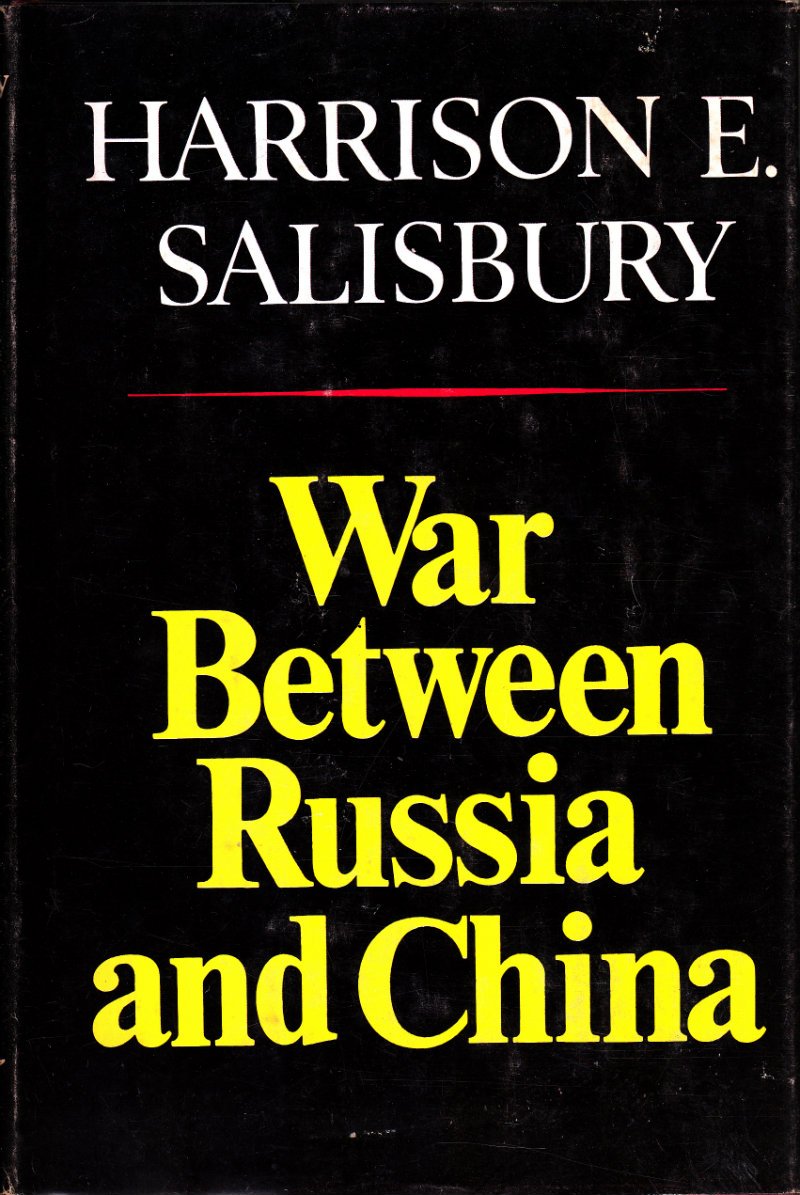
I had recently come across this book at a sale nearby and just finished reading it. I remember the early Cold War days but my knowledge at the time was very limited. I remember my Dad would tell us kids we didn’t want the Communists to take over because if they do, they’ll just take over our house and we’ll have strangers moving in with us and we’ll be kicked out. I was too little to understand anything then and people of my generation grew up believing a lot of things they were told as kids. The Atomic bomb was going to take us out and the communists were going to be the one’s who bomb us. One day, I think I was about 5 or 6 years old, a paper factory a few blocks down the street blew up and there was a big flash of light and the whole house shook, the windows rattled and all that. One of my older sisters went into a convulsions crying that the war has started and the bomb dropped on us. I was still only curious then so I don’t remember crying. It wasn’t until I read this book did I understand that the bomb threat was really between Russia and China but we would get fallout from the winds blowing it this way. Not many people knew what to expect back then so of course could only think the worst. I question now how well were we really informed back then compared to now. I don’t keep up with much, but this is the first time I even knew about this Russian and China as enemies. Back then, those bombs couldn’t reach us anyway, but we all lived in fear as if they could. How well are we informed now?

I think of the tipping issue in the service industry when I think about what I hear on the news these days. A few years ago there was lots of talk and debate over tipping and should people tip, but not a peep about the $2.65 an hour service workers made and who relied on those tips. Kitchen staff complained they never got a cut, etc. That was and still is the minimum wage for those service workers. However, if the wages were brought up to and above the minimum wages then the price of eating out would have to go up and nobody wanted that and the servers wanted to keep their tips. Since then, the service industry has suffered because those tips have not come back to what they were before. Now, only recently, a few years after all that blabbering, there was a brief mention of this below average minimum wage service workers make, but it was only brief, no extensive talks or debates, just a blurb most people probably didn’t hear. And this was on NPR! Our trusted news station!

The Birth and Death of an Era

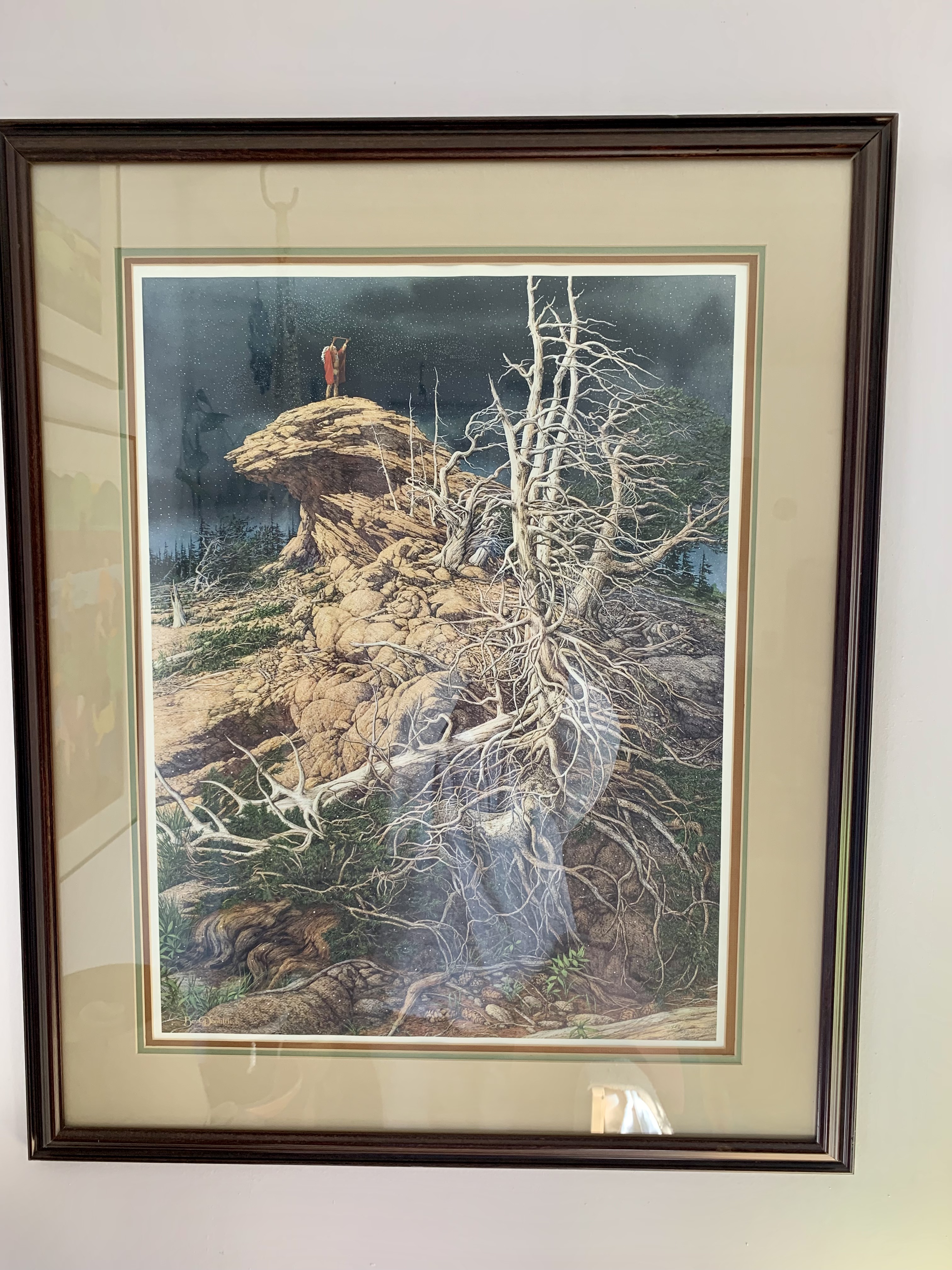
Prayer for the Wild Things by Bev Doolittle

Growing up in Dinkytown near the University of Minnesota campus was an adventuresome experience, as most childhoods are. I witnessed the birth of the franchise era, the grandparents of the big box shops and brand names today. There was a dance studio on the corner of 13th avenue and 4th street that my mother sent me to for ballet lessons. It had burned to the ground one day in the late early 1970’s. The area was then slated for a Red Barn chicken shop while there was already a Red Barn in Stadium village less than a mile away. I don’t think Red Barn was an actual franchise then but they were trying to be and the students and all got involved in a protest to ban it and prevent the growth of franchises in Dinkytown preserving the independent and uniqueness of the neighborhood, saving the small entrepreneur from getting pushed out or swallowed up by the bigger fish, or chickens in this case. The ban was successful and also the death of Red Barn more or less. They eventually closed in Stadium Village and was never seen again. Later on McDonald’s and Burger King managed to open their chain stores in Dinkytown without the protests and remained there for decades.

As I got old enough to drink I hung out in West Bank bars and enjoyed the bands. They used to sing about the days “a’comin” one by Willy Murphy and the Bumblebees titled “Supermarket” was one such warning of the chain store take over corruption of our society.

Today any city you travel to nearly any part of the world let alone America, the chain stores we are all familiar with have taken up roost so now just about anywhere you go there’s that “sameness”. Brand names are like these same shops, everybody has them or wants them just like everybody else. They’re a trusted source for what you want. Entrepreneurs from foreign lands now come in to give us something different and I see these businesses growing in numbers, familiarizing us with their cuisine and cultures. Though the big boxes aren’t dead yet and it’s still hard to predict where all this is going, the world changes from generation to generation.

Burger King and now McDonalds are both gone and so is my old high school. In place is Target a Starbucks, and a number of small businesses, turning out Banh Mi Vietnamese sandwiches and pizza’s with not the conventional toppings.

The film industry has hit the bricks hard. With digital photography many people in the industry lost their jobs or are suffering a massive loss of income. I have three neighbors who experience this. One had a fire and lost her equipment and after trying to replace her loss and come back into the business, was another hard hit for her because the industry wants younger people with their young perspectives. Basically, she was told she had aged out of the industry. Another neighbor who just moved back to Minneapolis I hear is having a hard time finding work because her arts have become obsolete. Another neighbor was just able to retire before taking this same hit. Eventually I’ll become obsolete too when Uber replaces drivers like me with robotaxis. People can make their own films and photos with a smart phone now and they do. Social Media and channels like Netflix are pushing out the bigger fish that was once Hollywood. However, they’re not all dead yet. The nostalgia might die with the generations that lived in those days but there are some things that never die. Music! and the Muses are eternal.

What I got out of this book is the playfulness of Hollywood characters. Many times I’ve heard actors and actresses comment on the people in Hollywood as people who never grow up. This book portrayed this well with the character who as a child was into building dinosaur models and such from the hobby kits of the day. The child never “grew up” but continued building his models and creating his make-believe landscapes for his beasts. As he got older he became very good at it and was able to build his own toys without kits and this eventually landed him a job in Hollywood as a set designer and monster creator for the movies. These people who have not put themselves above their toys and silly behaviors have done very well for themselves. Walt Disney had made it huge with his Disneylands and Worlds. He was probably one of the first to develop and use robotics to animate his characters and creatures. Emotional turmoils, silly behavior, gossip, pranks and such have kept their creative minds active and alive. This is the stuff that entertains the serious grown ups on television today. They make us laugh, care and cry, taking our noses off the daily grindstones of life even for just a little awhile.

So, Hats off for Immaturity!

THERE’S SOMETHING HAPPENING HERE…

A must read for anyone trying to understand today’s world.

Now selling like hotcakes on eBay and Amazon, I read this book and it sold the very next day on Amazon. I bought it off eBay with a free shipping and lower price, now you can probably do the same. I would encourage everyone to read this because the story effects every one of us in more ways than one.

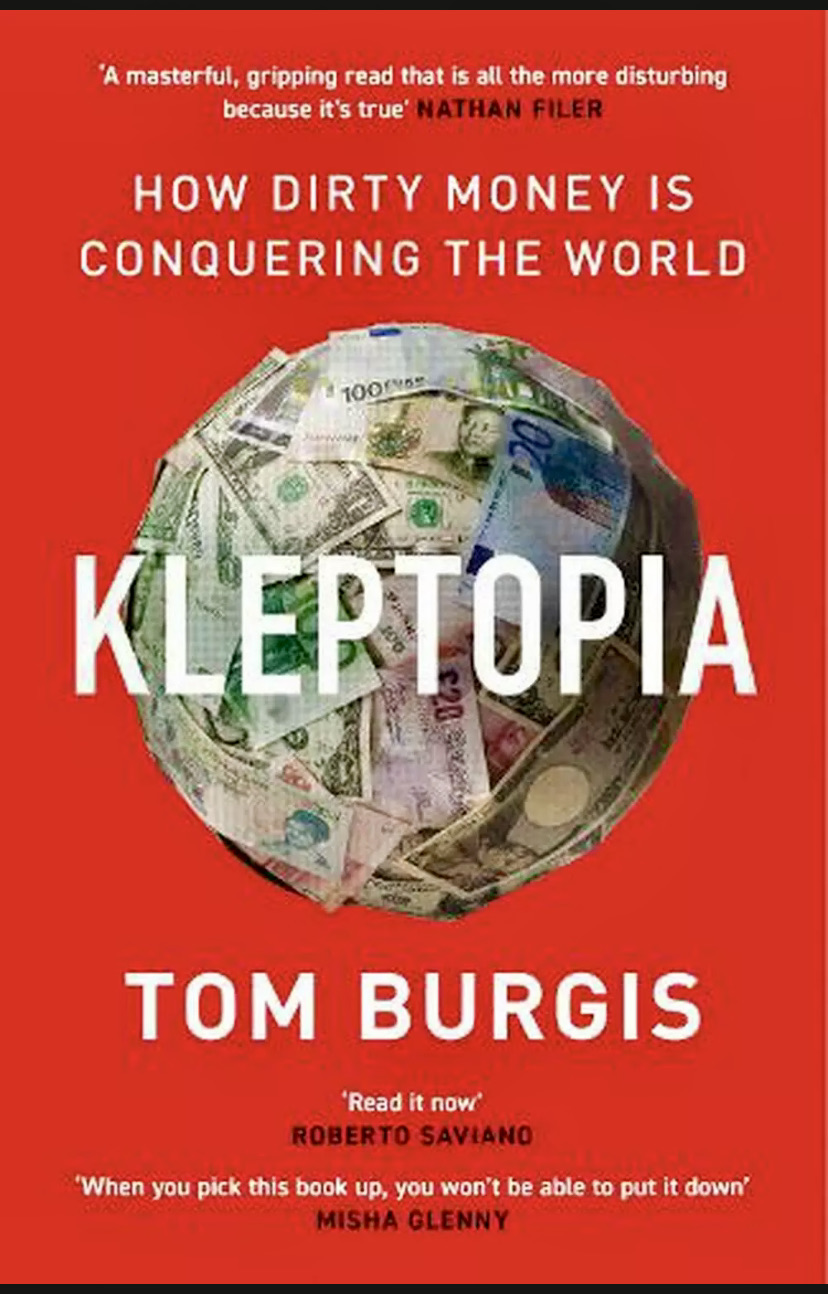
This one I expect will sell fast too. We’ve been hearing this whole story that is told in both books over the years in bits and pieces as the events happened on the news. What Tom Burgis did was take these events and drew the big picture. He explained well how resource rich nations remain in poverty, as we know the ruling elites basically skim all the wealth for their own, but also describes how the labyrinth of shell companies, tax havens, etc. and the parking of money in our own nation are impoverishing us.

This is something that should not only concern us, but anger us to no end, because here we go again with the banks involved just a deep in these schemes and shenanigans. Are we going to bail them out again?

If I were to allow the storage of stolen property on my premises, I would be convicted, so would anyone of us. We may also lose our homes and anything else of value. Parking looted cash from other nations through the real estate purchases and other means, isn’t that the same? Parking/storage stolen property/loot?

These deals have raised the price of housing so that the average American can’t afford even the tiniest of shacks and renters are paying astronomical rents because of a housing shortage! The properties of these Kleptocrats who are supposedly legally parking their money here are often empty or housing what a friend of mine calls “anchor baby hotels”, meaning the a pregnant wife or mistress of a kleptocrat that had gutted his own people can have a child born in the United States and obtains citizenship and can also have a bank account. Sanctions are a joke when there’s an anchor baby in the family with access to the these accounts.

I drove taxi for many years and now drive Uber. In the taxi I had lots of regular customers that would go from one job to the next and some would do this three times a day! They weren’t making a lot of money, but it took a lot of money just to survive. This is where we’re at folks, and over the years we thought of other reasons why, like greedy landlords, yes they’re out there, people just wanting more, they’re out there too. We all have taken a bite out of the apple, it’s in our gas tanks and our cell phones and nearly everything else we consume. There’s also the psychology that has become embedded in our lives as a consumer society itself. We are creatures of comfort, OK I get that. But over the years through the media and our peers, we’ve learned that we ain’t shit unless we’re rich and glamorous and have the latest shiny trinket of the day. We learned that success is based on how much we earn and not so much on how well we live whether we live in a shack or a penthouse. I can’t stress enough how hoarding is becoming more and more of a problem in this county too. Anyway, this might sound a bit religious now, but we have been taught to worship the “Golden Calf.” Remember that story? It’s in the Bible and probably other books too. And what happened, everything was destroyed in the end. Is that where we’re going now that this war has begun?

On that note here’s an example of one overworked worker:

Didn’t quite make it around that corner. “Hells bells! Din’t make it to the corner!”

Following up the Hoarder Saga

In 2019 I posted a couple of blogs about my hoarder neighbors. Since then a lot has happened. I had feared the worst in the beginning because of the risk the house would get condemned, but actually I came out pretty well. The health department stepped in for awhile because of a small child’s health was at risk of lead poisoning. Old houses like mine have lead paint all over them and the government has some generous grants to clean it up. This got me new windows in the attic all around, a railing installed at the top of the attic stairs, new steps going up to my apartment on the second floor, front and back, a new bathroom sink installed, two new windows in my dining room, the problematic peeling old wall paper base over plaster walls in the kitchen was fixed and they even painted ceiling.

Not a complete makeover but a lot of work I never would’ve accomplished on my own. I was inspired to paint my kitchen walls after that, getting rid of the ugly “renter’s white” color that made it look so squalid.

Meanwhile, the inspector is still busy trying to get my neighbor to clean up the basement. I learned a lot about hoarders since I’ve had to live through this. I’ve read a number of books on the subject that I have passed on to the inspector for his own use too. Generally, hoarders are very nice people and easy to get along with, a personality trait that’s a saving grace for them. However, they’re also very difficult. The inspector told me he’s had to take classes about hoarders and how to deal with them as an inspector. It would take a lot of government resources and can be very expensive to help a hoarder clean up and stay cleaned up than what the city can afford, and it’s a growing problem. Most people think hoarders are a poor man’s domain. Just the opposite. Most hoarders are from well off families, and it is not something they learned from their parents who lived through the Great Depression as many people seem to think. Hoarders are often broke because they’re also paying for off site storage units which can amount to just as much if not more than their monthly housing expense. Cities are still in the early stages of figuring out what to do about hoarders without condemnations and evictions. It’s a mental health issue and nothing short of a court order will a hoarder seek the counseling they need until they themselves acknowledge they have a problem. Five city dump trucks parked outside the house ready to clean it out isn’t convincing enough. A hoarder will continue to argue that it’s not that bad.

The Granddaughter who was in the basement with the baby has her own apartment now and seems to be quite happy with it. I haven’t seen the daughter around in awhile. I heard she’s moved about 20 miles away and probably living in somebody else’s garage. I don’t know. Anyway, all’s been quiet here.

PARTING WITH OLD FRIENDS

The Frozen Mississippi River still flows beneath the ice

It’s been over a year since I wrote a blog. I haven’t been too busy but I sure am lazy! As age sets in I think about what to do with my collections. I worked a flea market last summer and there was lots of interest in the few cigarette cards I had put out for sale. One buyer met up with me later in the year and bought an album of American cards from me that consisted of numerous cigarette cards, Arbuckle Coffee Cards and some gum cards. As sad as it was for me to say farewell to those pieces of my collection, it’s just as well for me to sell them now than to leave them for someone else to do it when I’m either not here anymore or I become unable to do so later. I’ve basically been out of the card scene for awhile so the interest from old Sports Cards collectors that have changed and come over to the non-sports cards is new to me. I have read that during the pandemic unemployment times cards have been bought and sold at a much increased pace than before, so maybe this new interest is most recent. However, I did monitor eBay and haven’t noticed anything new during that time. Perhaps I didn’t monitor it close enough. Anyway, the time comes when we should consider passing our collections on to other custodians. After all, that is what we are, custodians. Collections are a preservation of history and heritage and all have their place somewhere and in some time.

Most of my collection does consist of British cigarette cards, they’re not considered worth as much as the American cards, something I heard a couple of dealers remark on at the flea market. But the vast issues of cigarette cards are world wide. The American cards only cover a few subjects in comparison. Asia had numerous issues and some most interesting stories in connection of the subjects. South American sets are hard to come by but there are numerous single cards that can be found. African cards, Australian, New Zealand, Malaysia, Cochin China, a number of European, pretty much any continent and country had issues of cigarette cards. It was in the interest of the tobacco companies to sell their cigarettes and the little pictures inserted in the packs provided an incentive to smoke and collect. I would venture as far as to claim that there were people who probably learned how to read or at least advance their reading skills from the biographies printed on the backs of the cards. Nearly every subject was covered in cigarette cards issued by tobacco companies and there was also much to learn from them as well, like Air Raid Precautions during the World Wars, First Aid, How to make something, complete instructions on how to make a wireless radio was set issued in Britain. Germany had a photography set that illustrated to the collector on the use of shadow and light to enhance black & white photos. If you insist on only collecting American cards, you are missing quite a lot.

The list of subjects is endless. Everything under the sun had been depicted on cigarette cards at one time.

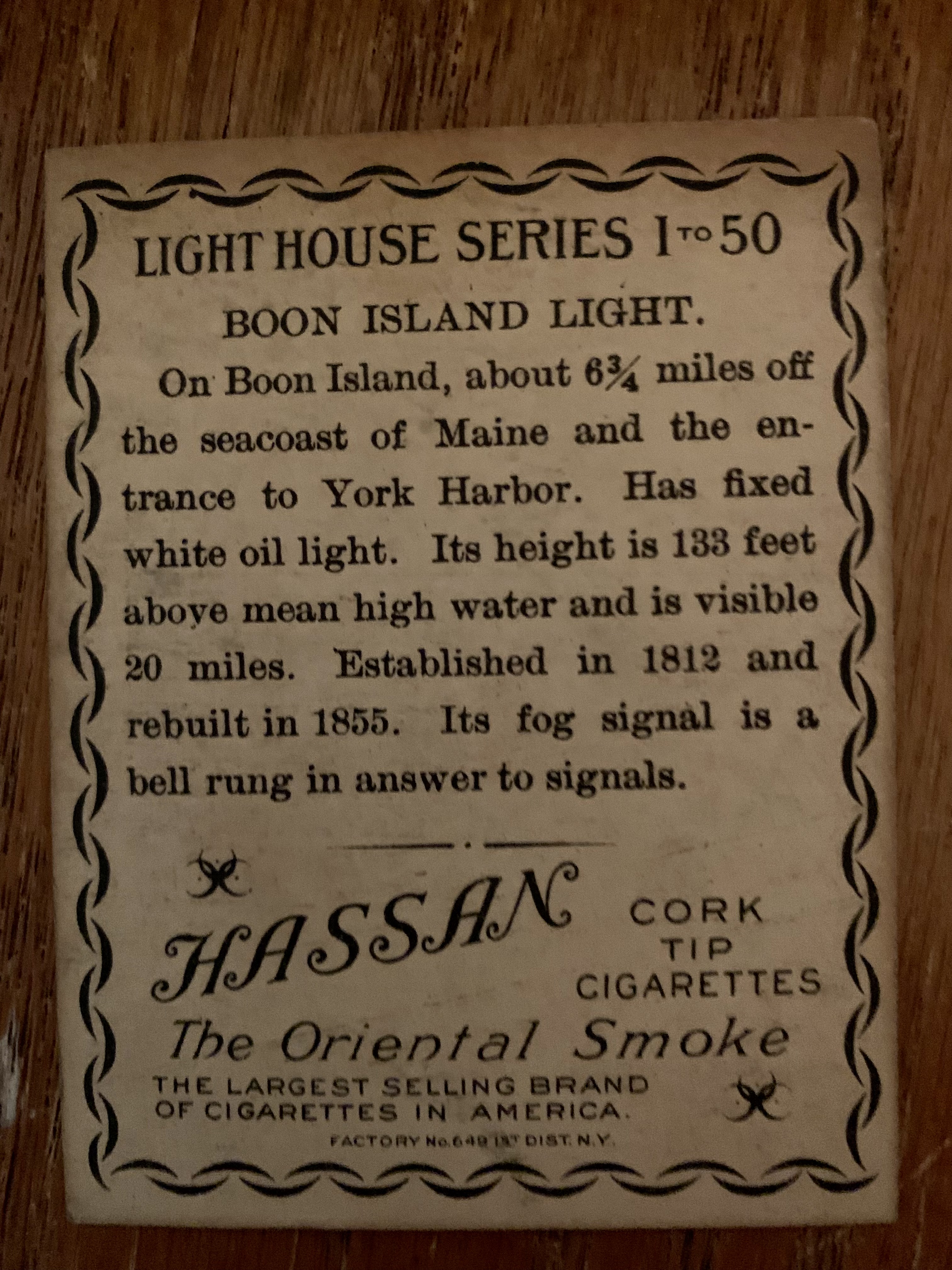
Hassan, The Oriental Smoke
Boon Island Light

Light houses have been a favorite of mine since childhood when I used to dream about living in one. This set of 50 Lighthouses is dated to 1910.

When was the last time you tried to cook a pigeon? There are 50 cards in this set titled “Cooking Subjects” dated 1889.

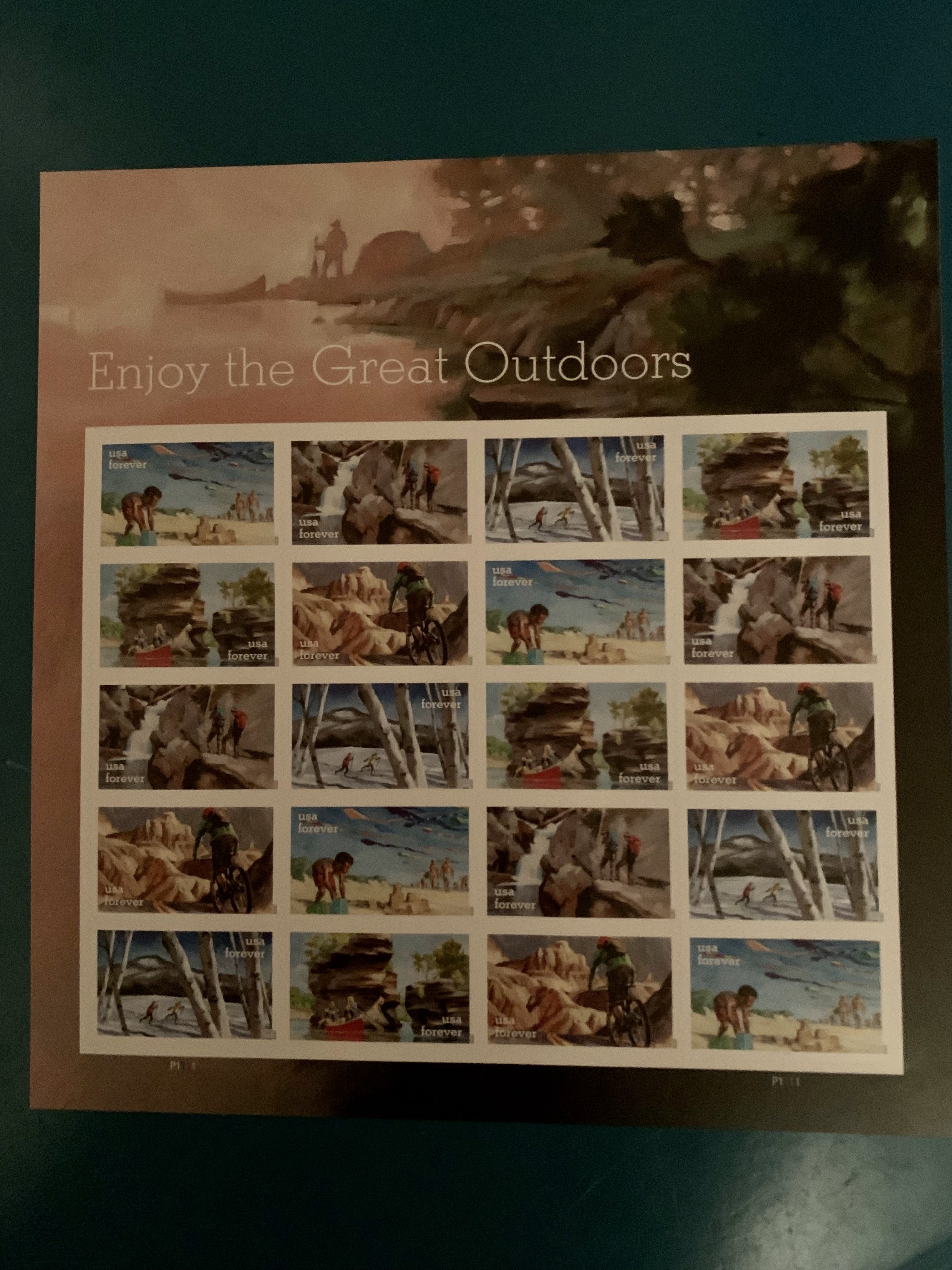
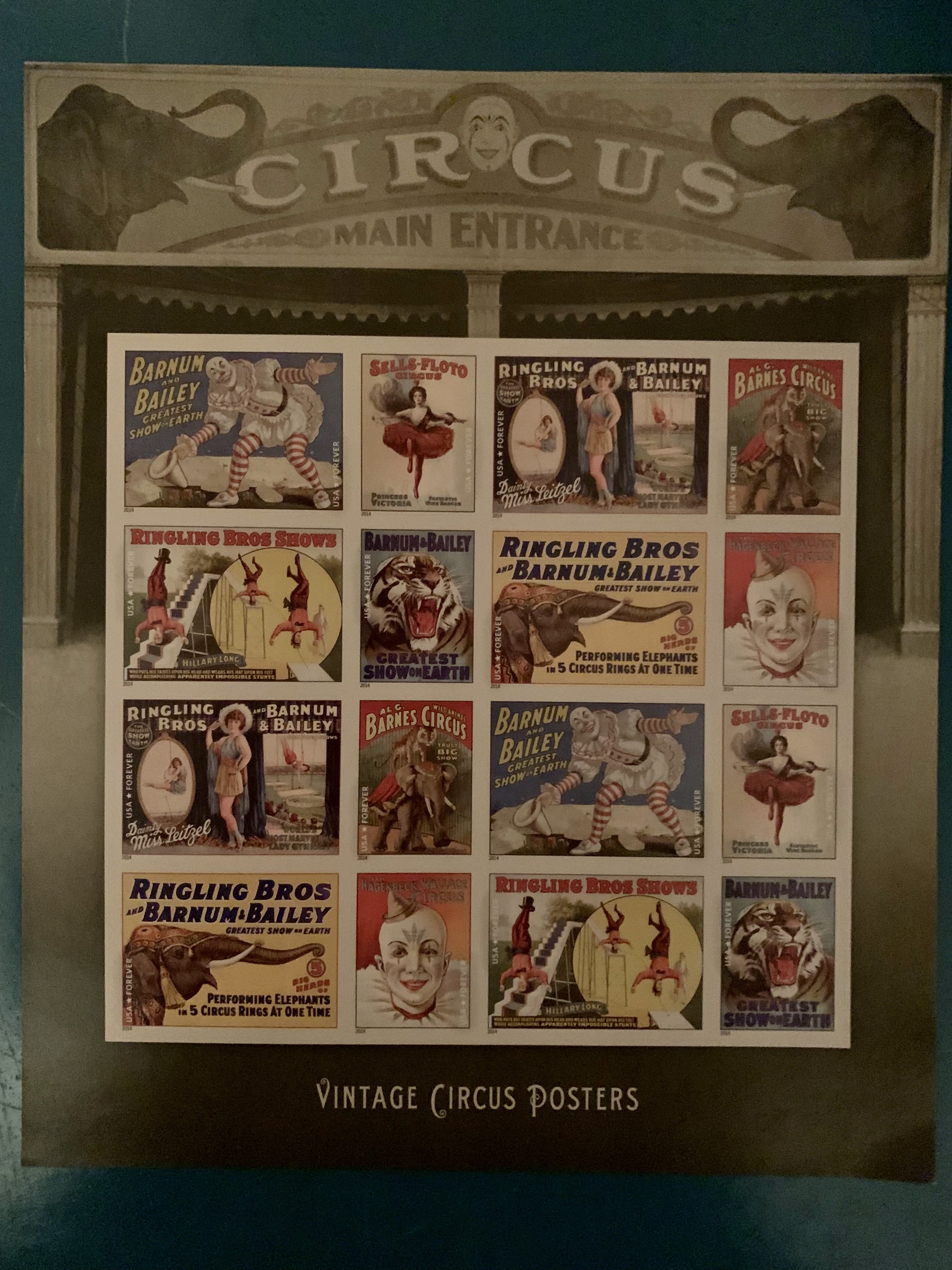
Postage stamps are another collection item. The Post Office entices collecting with all the pretty commemorative stamps in a display case. Many of us have a hard time using those stamps so they usually get stored in albums. With the Forever Stamps these collections never lose their usage with age. But if they don’t get used in a person’s lifetime, they’re often sold for less than their value at sales. I was told people buy them up and use them to pay the postage on packages, because even if they’re not Forever Stamps, they still have their face value.

Previous Older Entries